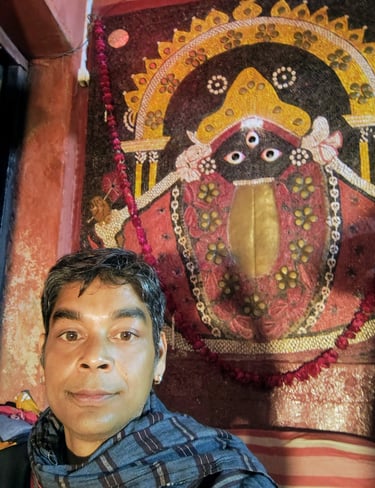
Dr. Kaustubh Das
About
Dr. Kaustubh Das is a scholar, practitioner, and initiate whose work sits at the intersection of rigorous academic study and living traditional practice.
He holds a multidisciplinary PhD from the Centre for Studies in Social Sciences, Calcutta (Jadavpur University), weaving together Indology, Yoga Studies, and Tantric Studies with Postcolonial Theory, Science Studies, and Consciousness Studies. Grounding his theoretical argument in participatory ethnographic engagement with traditional communities and practitioners, his research examines how the methodological presumptions of modern scholarship impose a materialist bias on consciousness-centric disciplines such as yoga and tantra. His work has appeared in peer-reviewed venues including Springer and the Journal of the Asiatic Society.
He has spent over two decades in direct encounter with sādhus, yogis, and teachers across India — fieldwork that extends beyond Kashmir Śaivism into the Sahajiyā Vaiṣṇava and Baul-Fakiri traditions of Bengal, where he has recorded and studied living oral and musical lineages. He has also trained for sixteen years in Iyengar yoga under senior teachers of the tradition.
Lineage & Initiation
Dr. Das is an initiate of the Anuttara Trika — the tradition of Abhinavagupta — through his teacher Mark Dyczkowski (1951–2025), one of the foremost scholars and practitioners of Kashmir Śaivism of his generation, and a direct disciple of Swami Lakshmanjoo of Kashmir. Dyczkowski's monumental works — the eleven-volume Tantrāloka with Jayaratha's commentary and the twelve-volume Manthanabhairava Tantra — remain among the most significant contributions to Kashmir Śaiva scholarship in the modern period.
Dr. Das is also an initiate of the Sahajiyā Vaiṣṇava tradition of Bengal — a second lineage of practice that runs alongside, and in dialogue with, his Kashmir Śaiva training, and which grounds his ongoing fieldwork among Baul and Vaiṣṇava singers.
By the grace of his Gurus, he brings both the rigour of a scholar and the understanding of an initiate — for whom this tradition is not an object of study but a living practice.